The World
Book Notes
The stories are fiction. The world is not. Want to know our sources for The Lamp of Darkness? You’ll find many of them below, chapter by chapter. For deeper notes woven through the full text, see the Go Further Edition on Amazon.
Prologue
We state that the prologue occurs 579 years after the Exodus. Where did we get that number? Kings I 6:1 says it was 480 years from the Exodus from Egypt until Solomon laid the foundation of the Temple, which occurred in the fourth year of his reign. Solomon ruled for 40 years (11:42), bringing us to 516 years after the Exodus. Yeravaum ruled for 22 years (14:20), his son Nadab ruled for 2 years (15:25). Baasa reigned for 24 years (15:33) and his son Elah became King for 2 years (16:8). Zimri ruled for 7 days (16:15) in the 27th year of King Asa of Judah. Omri then won a civil war and ruled Yisrael until his death in the 38th year of King Asa (16:29), resulting in 11 years from the rule of Zimri to the rule of Ahav son of Omri. Thus it appears that Ahav became King 577 years after the Exodus from Egypt, and the prologue segment occurs two years into his reign.
Chapter 1
Uriel finds the couple’s lost object. Is there any evidence that prophets really did such things? Yes — it is mainly those prophecies with great significance to the Biblical story that have been recorded in the Bible and other sources. However, we can see with the story of Saul, who goes to visit the prophet Samuel when looking for his father’s donkeys, that prophets were often engaged in more mundane tasks such as finding lost objects. — Samuel I 9:6
Silence is a fence for wisdom. — Pirkei Avot 3:17
More than the lamb wants to suck, the ewe wants to give milk — a statement by Rabbi Akiva that his desire to teach was greater than his students’ desire to learn (changed from a cow to a sheep because he’s a shepherd). — Gemara Pesachim 112a
Chapter 2
The bashful never learn. — Pirkei Avot 2:6
Here she is with her belly between her teeth — this phrase comes directly from the Talmud. — Mishnayat Rosh Hashanah 2:8
Am I in the place of the Holy One who has withheld the fruit of your womb? A quote from the Torah. — Bereshit (Genesis) 30:2
Chapter 3
It is not good for Man to be alone. — Bereshit (Genesis) 2:18
The crack in the altar. — Kings I 13:5
The Golden Calf — the construction of the two golden calves by King Yerovaum. — Kings I 12:28
Chapter 4
The hour is late, and for many of you the journey has been long; nevertheless, our time is short, our task is great, and our Master is pressing. — Pirkei Avot 2:20
Even ordinary dreams are one sixtieth prophecy. — Gemara Brachot 57b
Royalty wake at the third hour of the day. — Mishna Brachot 1:2
Wisdom is good with an inheritance. — Kohelet (Ecclesiastes) 7:11
All prophets have been wealthy. — Gemara Nedarim 38a
Music helps quiet the mind. — Rambam, Guide for the Perplexed; Sefer HaMaspik l’Ovdei Hashem (Rav Avraham ben HaRambam), as quoted by Rav Aryeh Kaplan in Meditation and Kabbalah
Chapter 5
Story of the two thieves. — A parable of the Ben Ish Chai
Frog talking to King David. — Introduction to Perek Shirah
Chapter 6
Prophets lose their prophecy before their deaths. — Guide for the Perplexed 2:45
Parable of the fish and the fox. — Gemara Brachot 61b
Chapter 7
The bear with the jewels — this story is cited in a midrash, except the response there is that the wise man sees the teeth, which we changed to the claws.
Chapter 8
The priests of the Baal cutting themselves as a form of worship. — Kings I 18:28
Chapter 9
When there’s peace, even idolatry can be overlooked. — Bereshit Rabbah 38:6
Every power a person has must be expressed, otherwise it decays, and decay is a small death. — Rambam, as cited in “Is There a Chance for Love” by David Ben Yosef, p. 47
Chapter 10
King Solomon’s works. — Kings I 9:10
Rechavaum’s friends’ encouragement. — Kings I 12:11
Only a King from the House of David can sit in the Temple. — Rambam, Mishne Torah, Kings and their Wars 7:6
Here are your gods that brought you out of Egypt. — Kings I 12:28
Do not bow before their gods, do not serve them, do not follow their practices; rather, tear them apart and destroy their monuments. — Shemot (Exodus) 23:24
Chapter 11
The girls dancing in the vineyard of Shiloh and calling out to the boys. — Shoftim 21:19–21; Gemara Taanit 30a–31b
Sparks do not shine in the bright light of day. — Gemara Shabbat 63a
In the Cave: Wealth
The way the sages understood wealth, strength, and wisdom. — Pirkei Avot 4:1
Chapter 13
Rain on Sukkot is compared to a servant who brings his master a drink and the master throws it back in his face. — Gemara Sukkah 28b
The Divine Presence rests with us in the sukkah. — Zohar, Parshat Emor 103a
Joshua curses Yericho. — Joshua 6:26
Idolatry leads to drought. — Devarim (Deuteronomy) 11:16–17
Eliyahu’s declaration. — Kings I 17:1; Gemara Sanhedrin 113a
Chapter 14
Eliyahu takes one of the three keys. — Taanit 2a; Eliyahu Zuta ch. 8
What the righteous decree, the Holy One carries out. — Gemara Moed Katan 15b
Chapter 16
The level near prophecy that gives Divine power. — Rambam, Guide for the Perplexed II:45
Ahav can search for people throughout the world. — Kings I 18:10
Chapter 17
Burying bodies with their feet facing Yerushalayim. — Pitchei Teshuva 262:2; Gesher HaChayim
Chapter 18
The Holy One creates the remedy before the malady. — Gemara Megillah 13b
The location of Mitzpeh as a guarded border town. — Hoshea 5:1
Chapter 19
The Holy One’s throne has the appearance of sapphire. — Yechezkel (Ezekiel) 1:26
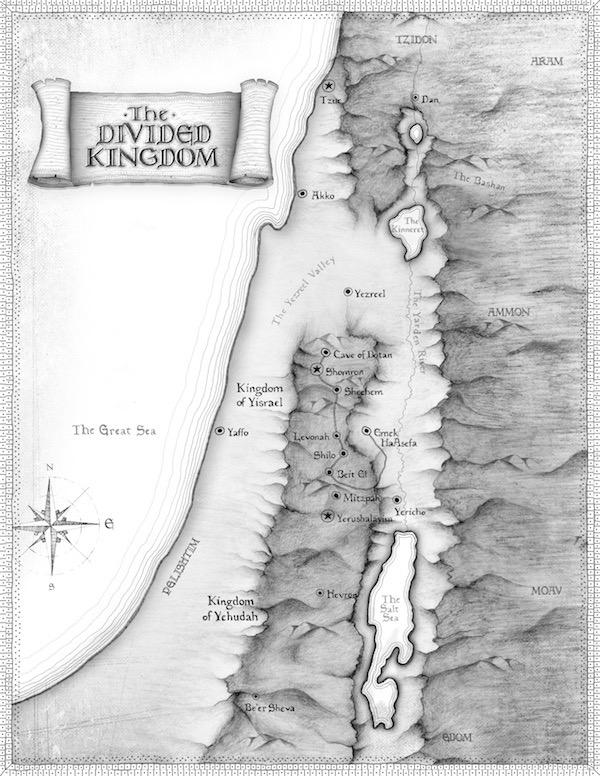
The Divided Kingdom
The land of the series, drawn by hand — the Kingdom of Yisrael and the Kingdom of Yehudah, from the Great Sea to the Salt Sea. Every journey in the books crosses this map.
The Events Behind the Series
A brief overview of the key Biblical events that set the stage for The Age of Prophecy.
Read the book these notes belong to — Book One is free.